The Zero Emissions Solutions Conference (ZESC) is a direct follow-up to key commitments in the Paris Agreement. In the Paris Agreement, every country is responsible for producing a Nationally Determined Contribution (NDC) for the period to 2030 as well as a Low-Emission Development Strategy (LEDS) to 2050 (Article 4, paragraph 19).
Combatting the climate crisis requires society to rapidly transform all of the systems that propel our economy, including power generation, buildings, industry, transport, land use and more. But by how much? And how can decision-makers make it happen?
The U.S. Trade and Development Agency is sponsoring the Forum and co-organizing with the Department of State and more than 10 other U.S. government agencies, in collaboration with the Confederation of Indian Industry, the Federation of Indian Chambers of Commerce and Industry, U.S. Chamber of Commerce, U.S. India Business Council, U.S. India Strategic Partnership Forum, and the U.S.-ASEAN Business Council.
This series will touch on themes including Tribal climate and health, community-led adaptation, and Indigenous sustainability practices. The sessions will include panels, individual speakers, and a documentary film. Mark your calendars for October 27, November 10, November 17, and December 1 from 11 am to 12:30 pm PT / 2 pm - 3:30 pm ET.
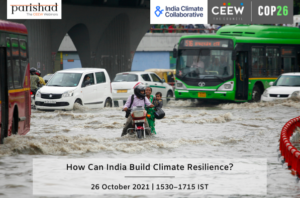
In this pre-COP session, speakers will explore ways to take climate risk assessments from theory to implementation and spur innovations in systems, finance, and technologies to climate-proof populations and economies. This session will also launch CEEW's new study, 'Mapping India's Climate Vulnerability: A District-level Assessment'.
The United States Agency for International Development (USAID) is proud to co-sponsor Clean Energy Week Cambodia 2021 from October 21-28 organized by EnergyLab Cambodia.
In this webinar, panelists will discuss the challenges and opportunities facing China’s pivot away from coal both at home and in its investments along the Belt and Road abroad.
Land is vital but finite. How can we reconcile humanity’s competing land demands with the need to combat climate change, protect biodiversity, and improve people’s lives?
On October 25, 2021 the Brazil Institute is honored to host a discussion on the role of state-level governments in strengthening conservation and pathways for sustainable development in the Amazon, with keynotes from Governor Flávio Dino of Maranhão and Governor Helder Barbalho of Pará followed by a panel discussion on opportunities and challenges for investment and sustainable growth in the Brazilian Amazon.
This webinar will endeavor to improve understanding of the gender-differentiated effects of climate change, and the role that these impacts play in the promotion of an inclusive and peaceful society.
This webinar is the last of a series of online events to be held in September and October under the common topic of “Halting deforestation: approaches and tools for forest-positive commodity value chains.”
Join IIED for the webinar, Financing long-term strategies: are least developed countries and funders aligned? on Tuesday, 19 October to explore whether expectations from least developed countries (LDCs) are being met for climate action in the form of long-term strategies and climate-finance delivery.
As prices for clean energy and storage technologies continue to fall and nations explore ways to cut emissions, integrating higher shares of variable renewable energy (VRE) becomes more urgent and complex.
To reach the 1.5-degree scenario, there needs to be a major shift in capital flows towards low-carbon, climate-resilient options. The right frameworks, tools and analysis are vital to countries enabling this shift today, leading us into the next decade.
The fifteenth meeting of the Conference of the Parties to the Convention on Biological Diversity will review progress and deliberate a post-2020 global biodiversity framework to build resilience and galvanize international cooperation amid growing environmental, health and development challenges.