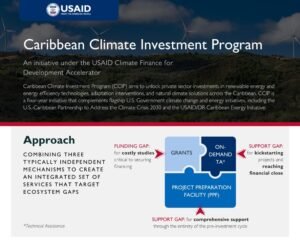
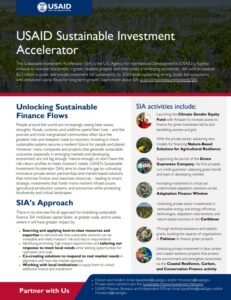
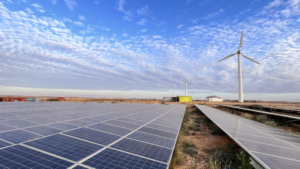
CCIP aims to unlock private sector investments in renewable energy and energy efficiency technologies, adaptation interventions, and natural climate solutions across the Caribbean.
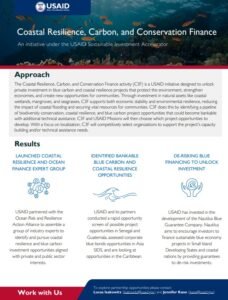
The Coastal Resilience, Carbon, and Conservation Finance activity is a USAID initiative designed to unlock private investment in blue carbon and coastal resilience projects.
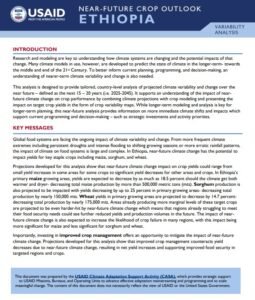
In Ethiopia, near-future climate change could affect the yields of key crops such as maize, sorghum, and wheat. Projections show potential yield changes ranging from small increases to significant decreases in some areas.
This policy outlines how the USAID Sustainable Investment Accelerator (SIA) will collect and store Sustainable Finance Investment Network (SFIN) member data, use partner network data, and share partner network data.
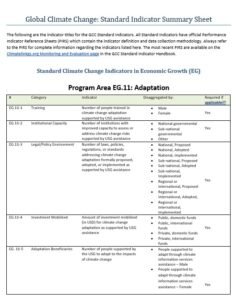
These templates have been designed to facilitate results reporting from implementing partners to their Contracting/Agreement Officer Representative (C/AORs).
These templates have been designed to facilitate results reporting from implementing partners to their Contracting/Agreement Officer Representative (C/AORs).
These templates have been designed to facilitate results reporting from implementing partners to their Contracting/Agreement Officer Representative (C/AORs).
These templates have been designed to facilitate results reporting from implementing partners to their Contracting/Agreement Officer Representative (C/AORs).
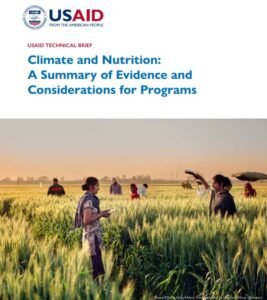
This technical brief provides guidance for taking climate issues into consideration when developing and implementing multi-sectoral nutrition programming.
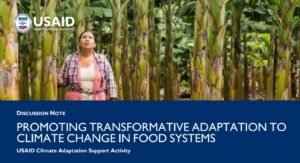
This Discussion Note outlines how USAID staff can support partner countries in pursuing transformative adaptation, efforts that go beyond coping strategies to seek large-scale, systemic changes.
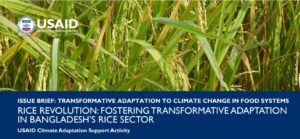
This issue brief explores resilience-building approaches, focusing on how USAID can support transformative adaptation in Bangladesh’s rice sector by building on current efforts to prepare the country for climate variability and change.
These slides were presented during the E.G. 12 Clean Energy Indicators and CLEER Tool for Calculating GHG Emissions Reductions webinar in the 2024 USAID Climate MEL Learning Series.
To facilitate more strategic collaboration and knowledge sharing, the BHA Watershed Community of Practice decided to develop and implement a learning agenda.
This brief is intended to summarize the current state of watershed management activities within Resilience Food Security Activities and associated activities and to serve as a foundation to identify topics for future learning.