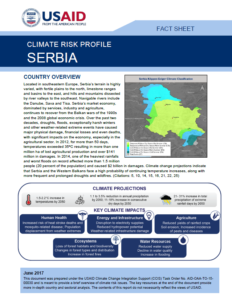
This profile provides an overview of climate risk issues in Serbia, including how climate change will potentially impact human health, energy and infrastructure, agriculture, ecosystems and water resources.
This webinar was hosted by the Tropical Forest Alliance (TFA) 2020 Latin America Working Group on May 26, 2017 to discuss the cattle sector in Brazil and solutions toward zero deforestation.
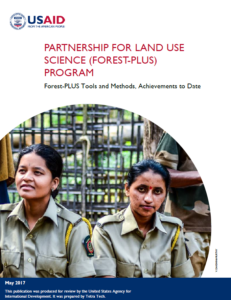
This report summarizes the tools, techniques and methods that Forest-PLUS has developed to support India’s successful implementation of Reducing Emissions from Deforestation and Forest Degradation (REDD+).
This video highlights the importance of regional, technical exchanges to identify the best climate service solutions in the world and to support regional dialogue around them.
This video features representatives from Ecuador, El Salvador, Colombia, Honduras, and Guatemala who describe how access to climate information and services is helping people build resilience to adverse climate phenomena.
The USAID Adapt Asia-Pacific Quick Guide to Climate Change Adaptation Funds is a collection of 10 multilateral and bilateral climate funds and initiatives currently available for financing adaptation activities in developing countries.
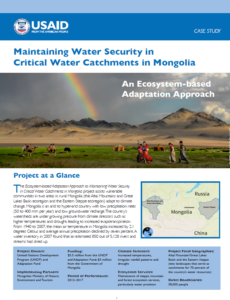
This case study provides information on the Ecosystem-based Adaptation (EbA) Approach to Maintaining Water Security in Critical Water Catchments in Mongolia project.
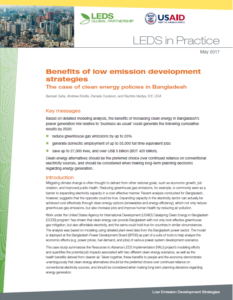
This case study summarizes the Resources to Advance LEDS Implementation (RALI) project’s modeling efforts and quantifies the potential job impacts associated with two different clean energy scenarios.
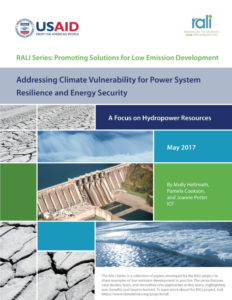
This paper aims to inform energy planners and investors about 1) how climate change can affect power generation resources, particularly hydropower resources; and 2) an approach that can be taken to address climate change risks.
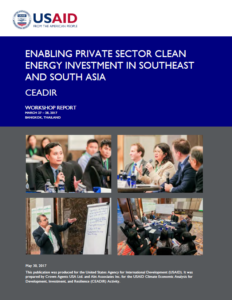
This report provides an overview of a workshop conducted in March 2017. 87 leading private sector and government representatives attended the regional workshop to discuss near-term opportunities to scale up clean energy investment in the region.
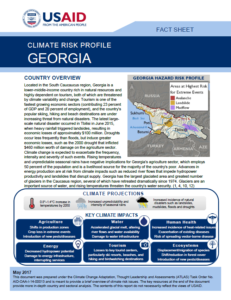
This profile provides an overview of climate risk issues in Georgia, including how climate change will potentially impact agriculture, water, human health, energy, tourism and ecosystems.
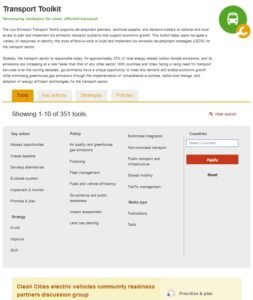
The Low Emission Transport Toolkit provides resources for development planners, technical experts and decision-makers at local and national levels, to plan and implement low emission transport systems that support economic growth.
The USAID-funded Mozambique Coastal City Adaptation Project (CCAP) is working with two vulnerable cities along Mozambique’s coastline to improve their municipal planning processes and adapt to climate change.
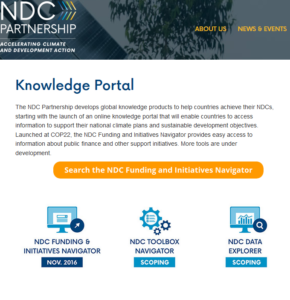
The NDC Knowledge Portal is an online platform designed to catalyze NDC support and implementation by providing knowledge products to help countries achieve their national climate plans and sustainable development objectives.
On May 9, 2017, the Clean Energy Solutions Center, in partnership with USAID and the National Renewable Energy Laboratory (NREL), hosted a webinar-based training titled Power Purchase Agreements for Grid-Aware Renewable Energy Procurement.
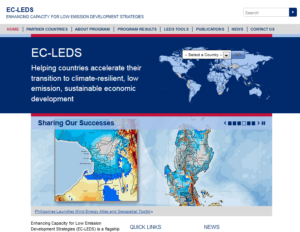
Enhancing Capacity for Low Emission Development Strategies (EC-LEDS) is a flagship U.S. program that has forged partnerships with more than two dozen developing countries committed to and taking concrete actions to achieve low emission development.