Over the course of time humans have built dams to store water, bridges to cross mighty rivers, and canals to divert water to farm land with little awareness about the impact these modifications have on river flows, and in turn on the health of the natural environment.
This fact sheet is an overview of USAID work in the Dominican Republic to increase the resilience of communities to the impacts of climate change in order to reduce insecurity and economic losses caused by climate change-induced severe weather events.
Indonesia Clean Energy Development (ICED) Project is a technical assistance program funded by the United States Agency for International Development (USAID) in the energy sector.
USAID's Global Climate Change Office offered a week of competency-based courses on climate change adaptation, mitigation and monitoring and evaluation for USAID staff in July 2016.
Through “climate smart agriculture,” USAID is promoting a variety of crop management methods to improve climate change resilience and ensure food security in a changing climate.
This fact sheet provides an overview of the Planning for Climate Adaptation Project in the Dominican Republic to increase the resilience of people to the impacts of climate change through improved municipal-level land use planning processes.
This fact sheet is an overview of the Improved Climate Information Project in the Dominican Republic which is increasing and improving climate change information for municipal and individual-level decision-making.
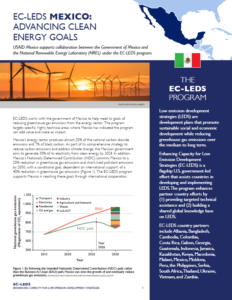
This fact sheet provides an overview of the collaboration between the Government of Mexico and the National Renewable Energy Laboratory (NREL) under the Enhancing Capacity for Low Emission Development (EC-LEDS) program.
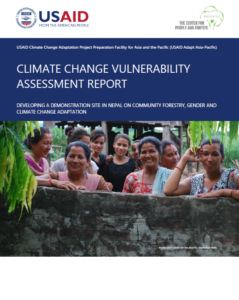
The Asia-Pacific region has some of the highest absolute numbers of people dependent on forests for significant portions of their livelihoods, and also stands to suffer some of the greatest expected economic and loss of human life as a result of adverse climate change impacts.
For countries to gain direct access to international climate change adaptation funds, like the Adaptation Fund, they not only need to be able to pass stringent accreditation requirements, but they also need the skills to prepare sound project proposals that meet the requirements of the financing agency.
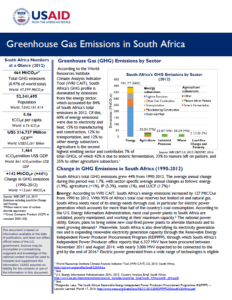
This factsheet breaks down greenhouse gas (GHG) emissions in South Africa in 2012 by sector, emissions trends, how emissions relate to gross domestic product (GDP) and the country’s mitigation strategies.
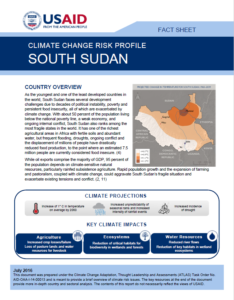
This profile provides an overview of climate risk issues in South Sudan, including how climate change will impact agriculture and pastoralism, water resources and ecosystems.
The Task Force on Climate-related Financial Disclosures (TCFD) is developing voluntary, consistent climate-related financial risk disclosures for companies to provide information to investors, lenders, insurers, and other stakeholders.
This “train-the-trainer" presentation is intended to build capacity among climate change champions to design and deliver trainings on low-emissions development strategies (LEDS).
This 2016 progress report on the US-India Partnership to Advance Clean Energy (PACE) program provides information on PACE, clean energy finance, renewable energy, grid integration of renewables, energy efficiency and energy access.