This video will teach you how to register the Global Forest Watch Map Builder Template with your organizational account on ArcGIS Online and create a custom web application.
The white paper includes an overview of global Intended Nationally Determined Contributions (INDCs), country profiles for countries, regional trends, and sectoral trends.
The webinar focuses on mainstreaming gender in energy sector projects and programs, which should enable both women and men to benefit equally from energy projects, reduce gender inequalities, and empower women.
This Manual was created for the Ministry of New and Renewable Energy (MNRE), Government of India in order to assist in achieving the National Solar Mission’s rooftop solar photovoltaic installation target of 40,000 megawatts by 2022.
The Ecosystem Profile Assessment provides technical experts and policy makers with a summary of the terrestrial and freshwater biodiversity resources within the Lake Victoria Basin and the most critical threats to these resources.
This paper, prepared by the India Partnership for Land Use Science (Forest-PLUS) Program, provides a comprehensive strategy for promoting sustainable forest ecosystem management in India.
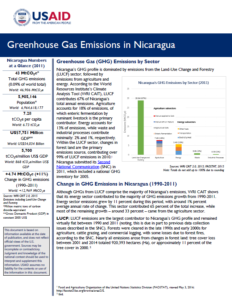
This factsheet breaks down greenhouse gas (GHG) emissions in Nicaragua in 2011 by sector, emissions trends, how emissions relate to gross domestic product (GDP) and the country’s mitigation strategies.
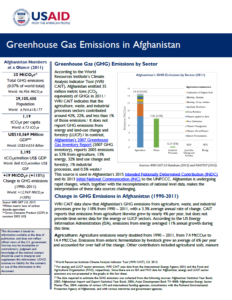
This fact sheet is an overview of 2011 greenhouse gas emissions in Afghanistan, changes in greenhouse gas emissions, emissions relative to gross domestic product and climate change mitigation targets and plans.
The Climate Change Adaptation, Thought Leadership and Assessments (ATLAS) Project undertook an assessment of the future economic costs of climate change in Indonesia to deliver actionable information for climate change adaptation programming and climate resilient development.
The Climate Change Adaptation, Thought Leadership and Assessments (ATLAS) Project undertook an assessment of the future economic costs of climate change in Indonesia to deliver actionable information for climate change adaptation programming and climate resilient development.
The Climate Change Adaptation, Thought Leadership and Assessments (ATLAS) Project undertook an assessment of the future economic costs of climate change in Indonesia to deliver actionable information for climate change adaptation programming and climate resilient development.
This profile provides an overview of climate risk issues in Southern Africa, including how climate change will impact agriculture, water, human health, ecosystems, infrastructure and energy.
The USAID-supported START program promotes research-driven capacity building to advance knowledge on global environmental change in Africa and Asia-Pacific.
The USAID Land Tenure and Property Rights Portal offers issue briefs, commentary, and documents related to how strengthening land and resource rights can help address climate change.
The Global Resilience Partnership works at multiple scales to help vulnerable people in Africa and Asia better adapt to shocks and chronic stresses and invest in a more resilient future.