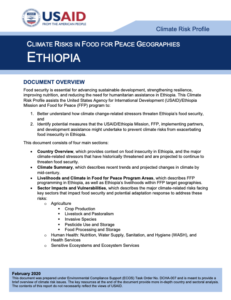
This profile provides an overview of climate risks to key sectors that impact food security in Guatemala. The document describes historical trends and projected near-term changes in climate, livelihood zones in FFP geographies, climate risks to the key food security-related sectors within the FFP geographies, and potential adaptation measures for managing these risks.
Governments around the world have recognized the potentially devastating consequences of climate variability and change to economic development, livelihood security and natural resources conservation.
This report analyzes the different ways that different actors can accelerate financing for investments in clean energy, sustainable landscapes, and climate adaptation.
The document describes historical trends and projected near-term changes in climate, livelihood zones in FFP geographies, climate risks to the key food security-related sectors within the FFP geographies, and potential adaptation measures for managing these risks.
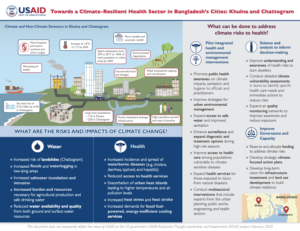
This infographic captures the climate and environmental risks to health outcomes in two of Bangladesh’s cities – Khulna and Chattogram – and summarizes recommended responses for both cities to address these risks.
The City of Cagayan de Oro (CDO) located in Mindanao, Philippines, faces natural hazards including flooding, landslides, and storm surge, each likely to be exacerbated by climate change.
Rapid urbanization, population growth and economic development are projected to increase global waste by 70 percent over the next 30 years—from 2 billion metric tons to 3.40 billion metric tons annually.
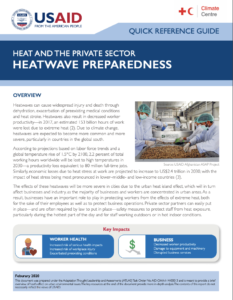
Heatwaves are generally associated with poor air quality, and the correlation between exposure to air pollutants and heat increases the burden of both cardiovascular and respiratory diseases.
This ProLand Sustainable Intensification Working Paper provides USAID with guidance on how to limit the risks of extensification resulting from USAID efforts to intensify agriculture.
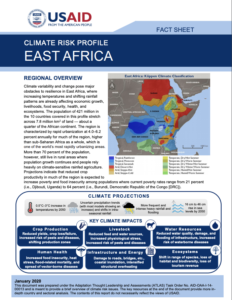
This profile provides an overview of climate risks in East Africa, including how climate variability and change likely will impact the region’s crop production, livestock, water resources, human health, infrastructure and energy, and ecosystems.
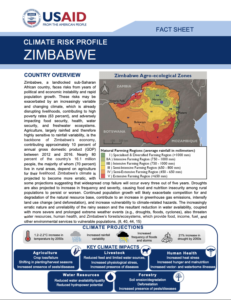
This profile provides an overview of climate risks in Zimbabwe, including how climate variability and change is likely to impact five key sectors in the country: agriculture, livestock, human health, water resources, and forestry.
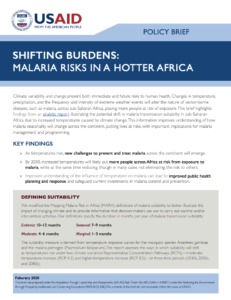
This policy brief highlights key findings from ATLAS’ technical report illustrating the changing risk profile of malaria transmission across sub-Saharan Africa and details recommendations and future opportunities to improve malaria programming.
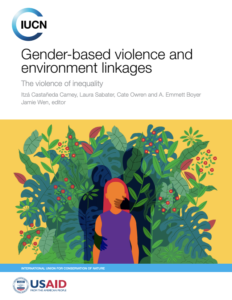
Rooted in discriminatory gender norms and laws and shrouded in impunity, gender-based violence (GBV) occurs in all societies as a means of control, subjugation and exploitation that further reinforces gender inequality.
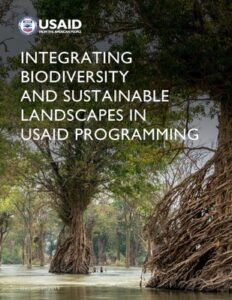
Integration of biodiversity and sustainable landscapes (SL) objectives and considerations has the potential to increase the sustainability of United States Agency for International Development (USAID) programming, amplify results, and save costs.
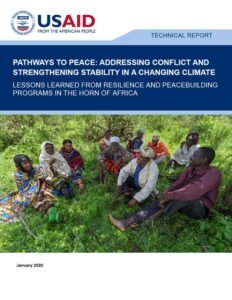
There is increasing evidence and recognition that climate variability and change is a risk multiplier that can exacerbate social, economic, and environmental pressures.