As countries implement greenhouse gas (GHG) mitigation projects to meet their nationally determined contributions under the Paris Agreement, they will need to begin aligning the measurement, reporting, and verification for projects with the national GHG inventory to ensure that climate progress is captured in their national reporting.
The City of Cagayan de Oro (CDO) in Mindanao, Philippines, faces several natural hazards including flooding, landslides, and storm surge, which are likely to be exacerbated by climate change.
This report provides an overview of historical climate trends and future projections, asses climate vulnerability in select sectors, and provide recommendations to improve climate resilience in South Sudan.
Energy efficiency has great potential to address economic development, energy security, and environmental protection around the world and in developing countries in particular.
Many countries face the challenge of strengthening and expanding electricity generation and infrastructure while incorporating climate resilience and greenhouse gas (GHG) reduction targets into long-term power planning.
These guidelines will support financial institutions to practically assess environmental and social risks and opportunities in agribusiness lending in Southeast Asia.
This technical document is intended to aggregate potential policy-relevant solutions to control air pollution and improve health in low- and middle-income countries (LMICs). The goal is to take an evidence-based approach to identify actions that may be applicable and encouraged to improve air quality management in cities and, through their influence, at the national level.
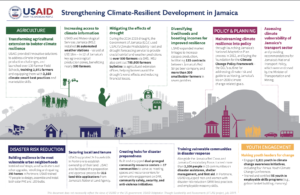
These infographics by the Adaptation Thought Leadership and Assessments project showcase high-level project successes from USAID/Jamaica’s rich and diverse portfolio of activities on climate resilience, advanced energy, and disaster risk reduction from 2012-2018.
Increasingly, cities are taking control of assessing local risks associated with climate variability and change and implementing adaptation strategies to mitigate impacts on their residents and the economic activity and infrastructure on which they depend.
This new guide, developed by the RALI team, provides instructions on how to apply the Harmonization Framework to mitigation activities within the Agriculture, Forestry, and Other Land Use (AFOLU) sector.
Agroforestry—the integration of trees with crops and livestock—generates many benefits directly relevant to the UNFCCC’s Koronivia Joint Work on Agriculture.
These guidelines assist banks to develop sustainability-linked loans for small and medium-sized enterprises in Southeast Asia with flexible terms and low-transaction costs.
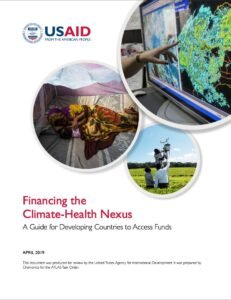
Climate variability and change are expected to increase health risks for a range of diseases and illnesses, particularly in developing countries where health care systems are already challenged by lack of resources and capacity.
In 2016, the impact of deforestation and forest degradation on the water supply to Malawi’s capital Lilongwe was so severe that the army was deployed to protect forest reserves.