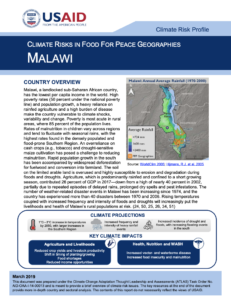
This profile provides an overview of climate risks in Malawi, including how climate change will potentially impact three key sectors in the country: agriculture; health and nutrition; and water, sanitation and hygiene (WASH).
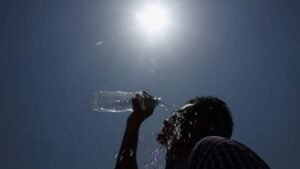
The March Adaptation Community Meeting focused on global efforts to better understand and respond to increasingly frequent and severe heat waves and their impacts on human health.
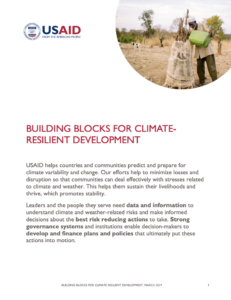
Based on global experience and best practice, the USAID Global Climate Change Office (GCC) developed four “building blocks” for climate resilient development.
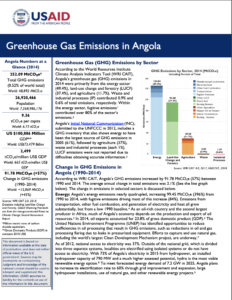
This factsheet provides information on 2014 greenhouse gas emissions (GHG) in Angola, including an overview of emissions by sector, changes in emissions, information on carbon intensity, as well as climate change mitigation targets and plans.
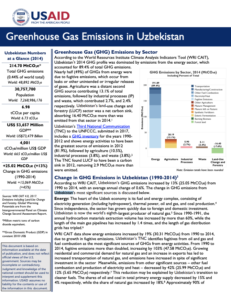
This factsheet provides information on 2014 greenhouse gas emissions (GHG) in Uzbekistan, including an overview of emissions by sector, changes in emissions, information on carbon intensity, as well as climate change mitigation targets and plans.
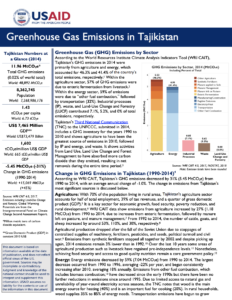
This factsheet provides information on 2014 greenhouse gas emissions (GHG) in Tajikistan, including an overview of emissions by sector, changes in emissions, information on carbon intensity, as well as climate change mitigation targets and plans.
Climate variability and change can pose risks to the integrity and performance of low-emission development (LED) investments, yet most LED planners don’t routinely consider the potential effects of climate on their projects.
Climate information services (CIS) systems can play a critical role in providing farmers with the information necessary to improve productivity, reduce risks, or enhance resilience to climate shocks and stresses.
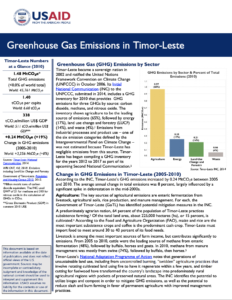
This fact sheet provides an overview of 2010 greenhouse gas emissions (GHG) in Timor-Leste, including emissions by sector, changes in emissions, and information on carbon intensity, as well as climate change mitigation targets and plans.
This case study shows how utilities can increase gender equality and promote women’s empowerment through institutional policies, examining management structures, and utilizing corporate social responsibility (CSR).
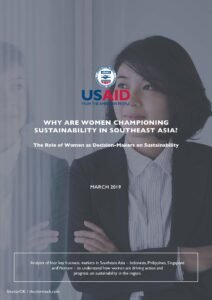
Analysis of four key business markets in Southeast Asia – Indonesia, Philippines, Singapore and Vietnam – to understand how women are driving action and progress on sustainability in the region.
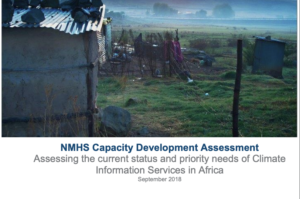
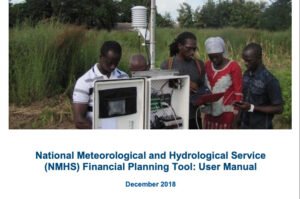
Despite covering a fifth of the world's total land area and having a population of over one billion, Africa has the least developed weather and climate observation network of all continents, and the network is deteriorating.
Many African National Meteorological and Hydrological Services (NMHS) contend with limited human capital, lack of financial resources, and obsolete technologies.
This Adaptation Community Meeting focused on examples of CEADIR’s support for climate adaptation, including public-private partnerships for disaster risk reduction and training on incorporating and financing climate adaptation in local planning.
Climate information services (CIS) have the potential to support sustainable and resilient development by providing information that can enhance agricultural production, mitigate harvest losses, protect and increase incomes, and improve food security.
In May 2018, USAID hosted the “Renewable Energy and Smart Grid Suppliers Forum" to engage U.S. firms interested in beginning or expanding business in developing country markets.