This white paper aims to illuminate women working in the energy sectors in Cambodia, Lao PDR, Thailand, and Vietnam as part of a gender and renewable energy assessment informing the program’s Gender Implementation Plan.
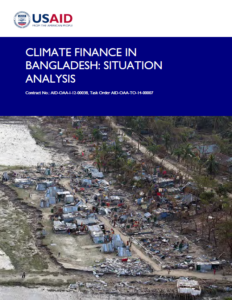
This report, created by the Climate Economic Analysis for Development, Investment, and Resilience (CEADIR) Activity for USAID/Bangladesh, assesses the environment for climate finance in Bangladesh.
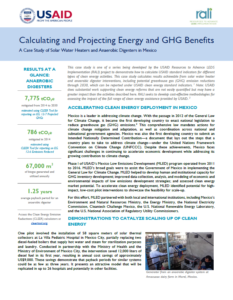
This case study is one of a series being developed by the USAID Resources to Advance LEDS Implementation (RALI) project to demonstrate how to calculate USAID standard indicators for different types of clean energy activities.
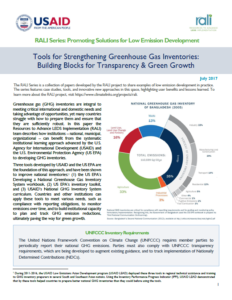
In this paper the Resources to Advance LEDS Implementation (RALI) team describes how institutions can benefit from the systematic institutional learning approach advanced by USAID and the U.S. Environmental Protection Agency to developing GHG inventories.
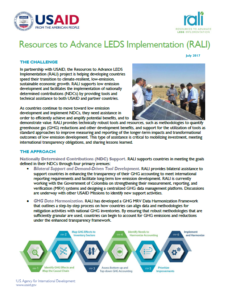
The Resources to Advance LEDS Implementation (RALI) project is helping developing countries speed their transition to climate resilient, low emission, sustainable economic growth.
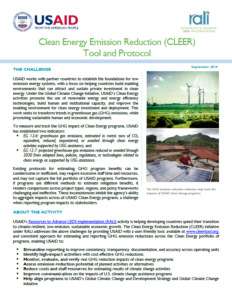
The factsheet explains why CLEER was developed, how it is improving the programs aimed at emissions reductions, the CLEER tool itself and calculators used to support the activity.
The Natural & Nature-based Flood Management page on World Wildlife Fund's (WWF) Environment and Disaster Management website includes information and resources about flood management.
This resource helps USAID staff and development practitioners find in-depth technical training on adaptation, clean energy, low-emission development, climate mainstreaming (integration) and land sector mitigation (sustainable landscapes).
USAID/Kenya and East Africa’s Planning for Resilience in East Africa through Policy, Adaptation, Research and Economic Development (PREPARED) Project brought together key partners to develop demand-driven tools to improve East African climate services.
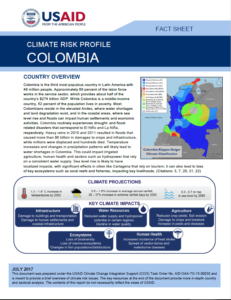
This profile provides an overview of climate risk issues in Colombia, including how climate change will potentially impact infrastructure, water resources, agriculture, ecosystems and human health.
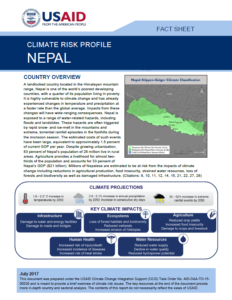
This profile provides an overview of climate risk issues in Nepal, including how climate change will potentially impact infrastructure, water resources, agriculture, ecosystems and human health.
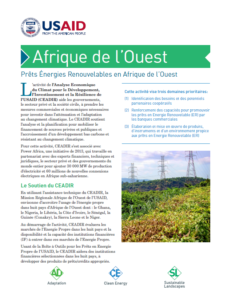
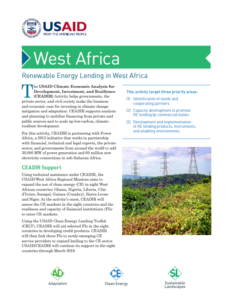
This document provides information on renewable energy lending in West Africa that is being supported through the USAID Climate Economic Analysis for Development, Investment and Resilience (CEADIR) project.
This document provides information on renewable energy lending in West Africa that is being supported through the USAID Climate Economic Analysis for Development, Investment and Resilience (CEADIR) project.
The SERVIR program is a joint development initiative of USAID and NASA that builds developing countries’ capacity to apply satellite data to decision-making for food security, water resources management, disaster management, and land use.
This video highlights how big data and modern information technology can be harnessed to provide farmers with more reliable information on what to grow, where to grow it, and when to grow it based off of weather and climate data.
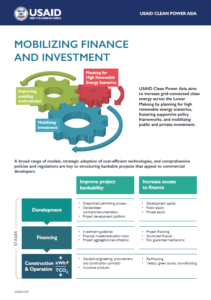
This fact sheet provides an overview of how the USAID Clean Power Asia initiative aims to increase grid-connected clean energy across the Lower Mekong by mobilizing public and private investment.