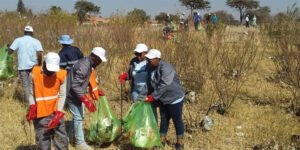
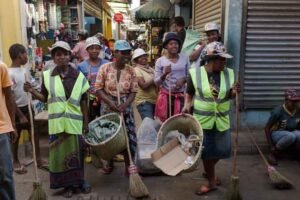
USAID’s Resilient Waters Program supported the South Africa Department of Water, Sanitation and Human Settlements’ river clean up event to raise awareness about the importance of healthy rivers.
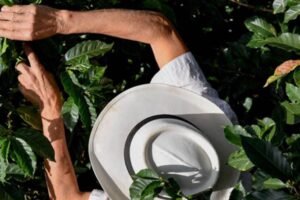
The USAID Feed the Future Learning Community for Supply Chain Resilience is happy to share the launch of a new website aimed to provide coffee companies with the resources they need to combat climate change. The Climate Smart Coffee website, launched in early May, was created to increase private sector engagement and funding in smallholder farmer resilience against climate change.
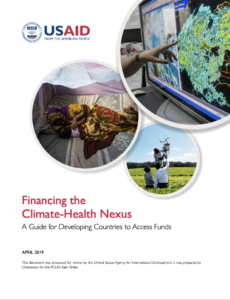
The new Financing the Climate-Health Nexus Tool from the Adaptation Thought Leadership and Assessment (ATLAS) project summarizes available sources of funding that are the most relevant and feasible for financing initiatives addressing climate risks to human health.
Droughts are slow-onset disasters that trigger significant environmental impacts, including loss in agricultural productivity across the globe. The Lower Mekong region is no exception.
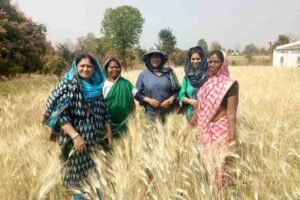
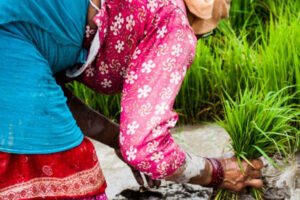
Samantabai is a happy woman. The first 'super-champion' farmer in her village, she has been involved in the Climate-Smart Village (CSV) project under the CGIAR Research Program on Climate Change, Agriculture and Food Security (CCAFS).
In November, I took a canoe trip down a rural western Madagascar river expecting to see a lot of lemurs, but instead I saw thousands of hectares of burned-down forest. The problem extends all over Madagascar, even encroaching on national parks.
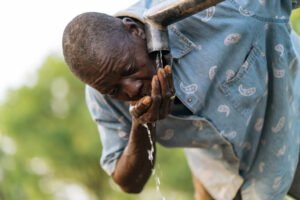
Children with dirty hands. Long lines at public water points. Cholera sweeping through a densely populated settlement. In the short-term, these public health issues can often be solved through Water, Sanitation and Hygiene projects – WASH, for short.
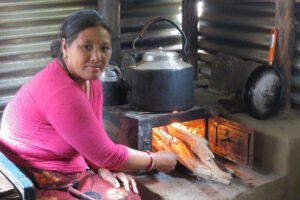
Women in Nepal used to walk to the forest to collect loads of heavy firewood for cooking. The task itself was burdensome, and the resulting smoke from the fires they built at home often caused respiratory problems.
The 2015 Rockefeller Foundation-Lancet Commission on planetary health final report, “Safeguarding Human Health in the Anthropocene Epoch,” begins: “Far-reaching changes to the structure and function of the Earth’s natural systems represent a growing threat to human health.”
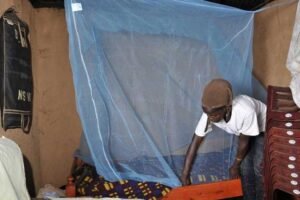
Malaria is a treatable and preventable disease, yet malaria kills one child every 30 seconds, or about 3000 children every day. Nearly 92 percent of these cases occur in Africa.
The countries that share the Hindu Kush Himalaya (HKH) – Afghanistan, Bangladesh, Bhutan, China, India, Myanmar, Nepal, and Pakistan – frequently experience agricultural, hydrological, meteorological, and socioeconomic droughts.
This month saw the release of a dire UN report from the Intergovernmental Science-Policy Platform on Biodiversity and Ecosystem Services (IPBES) warning that nature is declining globally at rates unprecedented in human history.
The Democratic Republic of the Congo (DRC) needs a comprehensive map of development. The country holds the largest contiguous block of rainforest outside of Brazil, but as the map below illustrates, much of the remaining forest falls under mining, oil and logging permits.
Landscapes and the complex, interlinked spatial units that comprise them are changing at an accelerating rate. Land use change, especially deforestation and forest degradation, are among the main contributors to global greenhouse emissions.
Cyclone Idai left more than 1,000 people dead and thousands more missing, potentially affecting millions in Southern Africa. As emergency response and recovery efforts continue, another disaster is likely unfolding elsewhere on the continent: Idai pulled precipitation South, away from Eastern Africa, resulting in persistent dry conditions affecting crops at the start of the main growing season. That’s where NASA Earth Observations come in.
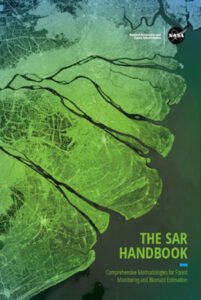
Synthetic Aperture Radar (SAR), due to its all-weather capability and observational characteristics, is a vital tool for assessment of forest structure. Nonetheless, there has been a knowledge gap in the applied use of SAR technology for forestry applications.
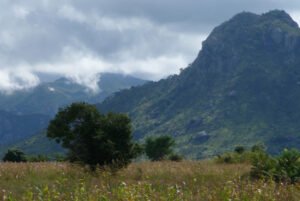
As my third trip to Malawi in a year came to an end, it was apparent that we have reached a milestone that many might not have thought achievable when we started this project five years ago. On April 4, I attended the launch of Malawi’s new National Greenhouse Gas Inventory System (GHG-IS), where Government of Malawi officials delivered speeches fully endorsing the system.