This month Climatelinks focused on policies, programs, finance facilities and partnerships contributing to the rapid scale-up up clean energy. Here are the many reports, case studies, blogs, tools, websites, videos and webinars that the Climatelinks community shared with us on the topic.
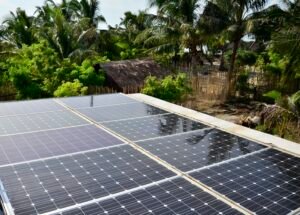
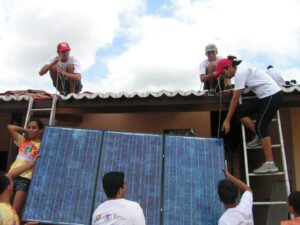
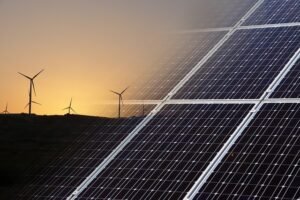
Distributed solar, the use of small-scale solar distributed over a local area, can be a powerful tool to reduce greenhouse gas emissions from the electricity sector.
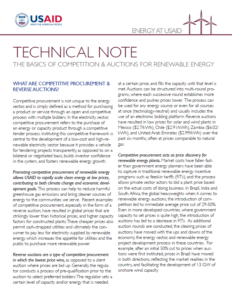
A technical note by a Presidential Management Fellow for USAID’s Energy Division, Sarah Lawson, called “The Basics of Competition & Auctions for Renewable Energy,” explains how new procurement processes for renewable energy work and why they are changing the landscape.
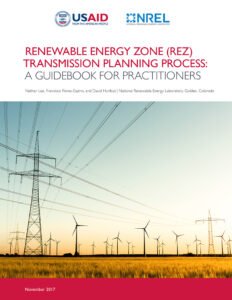
USAID and the National Renewable Energy Laboratory have partnered to transfer lessons from Texas state's expansion into wind energy to improve transmission planning by integrating renewable energy deployment and transmission system expansion in developing countries.
At the October 19th Adaptation Community Meeting, Dr. Molly Hellmuth, the focal point on water for ICF’s Climate Adaptation and Resilience team, discussed climate risks to hydropower systems and demonstrated some tools that are available to manage those risks.
On September 28, USAID/El Salvador signed agreements with three commercial banks in El Salvador to offer more than $53 million in partial loan portfolio guarantees under USAID’s Development Credit Authority (DCA) program.
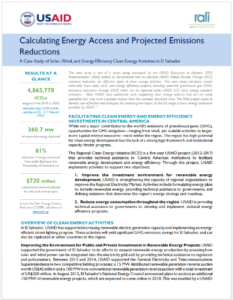
USAID supported an assessment of the energy and greenhouse gas emission benefits associated with USAID’s renewable energy development and energy efficient street lighting efforts in El Salvador using the online Clean Energy Emission Reduction (CLEER) Tool.
Climate-smart agriculture must go beyond promoting static solutions to climate variability and change, since this does not prepare farmers and their systems to adapt as the climate continues to change.
This month Climatelinks focused on the many elements of agriculture that touch on and are impacted by climate change. Explore below the many resources, blogs, knowledge portals and communities of practice related to this topic, shared with us by Climatelinks community members.
On Thursday, October 12, 2017 Climatelinks and World Wildlife Fund (WWF) hosted a Twitter chat to explore the benefits of integrating biodiversity conservation and adaptation.
From 23 to 25 August, seventy participants from national meteorological services, international partners, as well as expert practitioners, policymakers, and researchers from agriculture, health, disaster risk reduction, water resource management, education and finance reviewed current tools and offered recommendations for new climate tools for drought risk management in Eastern Africa.
Innovation and technology play important roles in addressing the need for climate-smart agriculture that can increase productivity and build resilient food systems. But how can we persuade governments and the private sector to invest in these climate-smart agricultural technologies?
The direct consequences of climate variability and change on the health of vulnerable populations are fairly well established, but there is emerging evidence that the indirect consequences are just as insidious, detrimental and widespread.
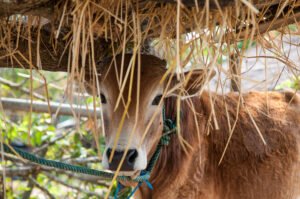
In their nationally determined contributions (NDCs), 92 developing countries mentioned livestock-related emissions, and 48 of the 92 explicitly mentioned intentions to reduce emissions from livestock-related sources such as enteric fermentation, manure management and biogas, and grasslands and silvopastoral systems. But how do countries plan to document reduced emissions?