Climate change is widely understood to be a significant driver of future patterns of human well-being. This paper seeks to quantify the impact of climate change on future levels of poverty across different income thresholds and scenarios modeling the impact of climate change on future patterns of human poverty across various thresholds and scenarios.
Bienvenidos a una nueva edición del boletín trimestral del Programa Regional Ambiental para laAmazonía (AREP).Ha pasado un año desde el lanzamiento de la Estrategia Climática de USAID hacia el 2030.
USAID lance, à l’intention des consortiums d’organisations éligibles, un appel à propositions de solutions d’autoproduction d’énergie renouvelable pour les entreprises agricoles et de pêche au Sénégal, dans le cadre du Programme de valorisation à grande échelle des énergies renouvelables (SURE).
USAID invites consortia of eligible organizations to respond to the Scaling Up Renewable Energy (SURE) Senegal Solar Power Applications in Agribusinesses and Fisheries in Senegal Call for Applications.
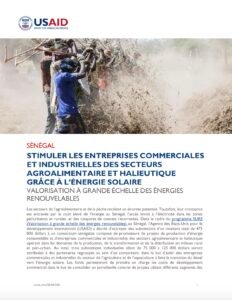
Le passage à l’énergie solaire dans les secteurs de l’agriculture et de la pêche au Sénégal permettra au gouvernement et au secteur privé du pays de promouvoir une croissance économique portée par l’agriculture.
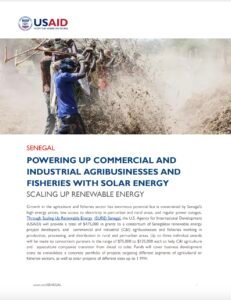
Transitioning Senegal’s agriculture and fisheries sector to renewable energy will help the Government of Senegal and the private sector support agriculture-led economic growth.
Requesting Policy Support to scale up Conservation Agriculture and ‘Elephant Aware’ farming practice as an approach to agriculture sustainability and food security in Botswana.
USAID’s Clean Cities, Blue Ocean program seeks to build local government capacity, so they are equipped to manage their waste systems and advance local circular economies.
In 2022, Measuring Impact II helped USAID review 111 activities over the last 10 years to understand how the Agency’s Biodiversity programming is already addressing climate impacts.
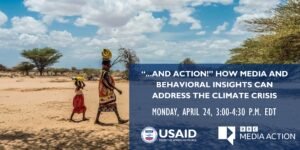
USAID and BBC Media Action recognize the critical role that media can play in helping people to make informed decisions, shift behavior and take action on climate change. This event explored the ways in which media and behavior change communication can support climate action on multiple fronts.
The purpose of this technical brief is to help readers make connections about the relationship between climate change and conflict. It provides USAID’s definition of climate security, and highlights multiple ways in which climate change and conflict interact, and describes approaches for USAID programming.
A changing climate has unleashed devastating droughts, floods, storms, and other shocks that imperil the lives and livelihoods of billions. Recognizing that this decade will be decisive for the future of our planet, USAID launched a Climate Strategy in April 2022 anchored in ambitious actions to reduce carbon emissions, including the Agency’s own, and help partner countries adapt to climate impacts and build greater resilience to climate change.
Establishing carbon footprint baselines for Robusta coffee production is a critical first step in the journey toward Net Zero and an important guidepost to inform collaborative climate action.
This manual will help you as a learner to understand the topic of Integrated Water Resource Management. Different issues under this topic will be discussed.
This video, developed under the USAID-funded Policy, Advocacy, and Communication Enhanced for Population and Reproductive Health (PACE) project, is a how-to guide for advocates of family planning, reproductive health, and gender equality on how to integrate their work in climate adaptation and resilience programs and finance streams.