The Amalima Loko program is a five-year USAID/Bureau for Humanitarian Assistance (BHA)-funded Resilience Food Security Activity (RFSA) designed to improve food and nutrition security in Zimbabwe through increased food access and sustainable watershed management.
This webinar discusses the assessment's findings and the 10 Climate Finance Levers that USAID could potentially apply to increase the scale of investment in clean energy and energy efficiency in partner countries. Explore the full report and an associated primer for more information.
The CGIAR Research Program on Climate Change, Agriculture and Food Security (CCAFS), through its Flagship on Low-Emissions Development—otherwise known as Flagship 3 (FP3)— seeks to address the increasing challenge that global warming is placing on agricultural practices, policies and measures and the overall challenge of declining food security.
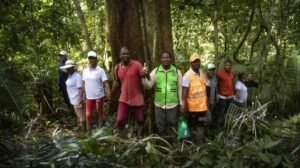
The purpose of the Amazon Indigenous Rights and Resources (AIRR) project is to improve participation of Indigenous Peoples in the sustainable economic development of the Amazon, ultimately leading to the conservation of biodiversity and reduced emissions from forest loss.
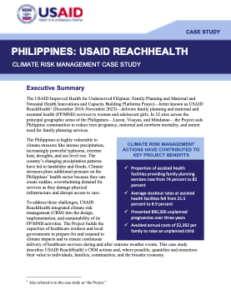
In the Philippines, the USAID ReachHealth Project delivers family planning and maternal and neonatal health services to women and adolescent girls. Family planning services are essential for the health of these populations because they promote healthy timing and spacing of pregnancies. The Philippines is highly vulnerable to climate stressors, which can create sudden, overwhelming demand for health services even as they damage physical infrastructure and disrupt access to care.
This report aims to present a high-level overview of the major accomplishments and lessons learned by the Vietnam Forests and Deltas Program over a nearly nine-year period.
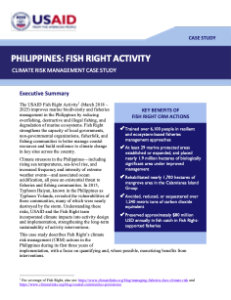
This case study describes Fish Right’s climate risk management (CRM) actions in the Philippines during its first three years of implementation, with a focus on quantifying and, where possible, monetizing benefits from Program activities.
This report offers an overview and analysis of the current climate adaptation finance landscape from a gender perspective. Drawing from a comprehensive desk review of existing programs and interviews with key stakeholders, the report highlights existing public and private approaches to gender-responsive climate adaptation finance, as well as opportunities to expand on this important work.
This event brings two leaders in the field to discuss challenges and opportunities and how intersections between education and climate change are currently conceptualized.
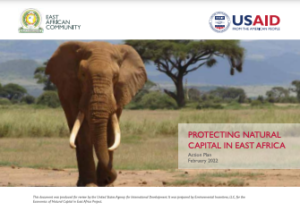
To implement this Action Plan will require stakeholders working across boundaries and sectors to protect their shared natural wealth and ecosystem services on which millions of people in the East African Community (EAC) region depend.
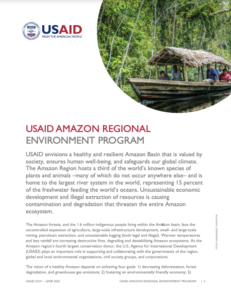
USAID envisions a healthy and resilient Amazon Basin that is valued by society, ensures human well-being, and safeguards our global climate. The Amazon Region hosts a third of the world’s known species of plants and animals –many of which do not occur anywhere else– and is home to the largest river system in the world.
This webinar provided an overview of the Nationally Determined Contributions (NDCs) and National Adaptation Plans (NAPs) under the UNFCCC, and highlighted USAID and USG support to partner countries in implementing their NDCs and NAPs to reduce emissions and promote climate resilience.
These videos from USAID's Paramos & Forests Activity highlight local Colombian climate efforts, ranging from Indigenous Peoples' involvement in the carbon market to ecotourism as an economic alternative to logging.
This paper highlights USAID’s core principles on HDP coherence and focuses on some day-to-day programming approaches that USAID and its IPs have learned through promoting coherence as well as some key challenges identified through consultations with 20 USAID partners.
This case study describes the project’s climate risk management (CRM) actions in Haiti's vulnerable urban and ex-urban areas, focusing on the benefits that can be quantified—and where possible, monetized.
This assessment is provided as a concise resource that can serve as an evidence base to guide investment and management decisions by all actors in the livestock additive supply chain.
This analysis aims to measure global progress on the inclusion of gender considerations and the adoption of gender-responsive policies and programming, showcasing good examples of gender-responsive components.