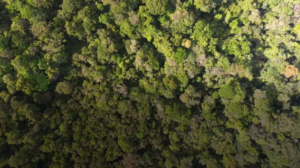
Edinson Palacios Mena ha vivido de la tala de madera casi toda su vida; él es el representante del Consejo comunitario afrocolombiano de Apartadó-Buena Vista en El Carmen del Darién, Chocó, una de las zonas más biodiversas del planeta.
The primary purpose of this document, and the full assessment from which its content is derived, is to assist USAID staff in identifying opportunities for designing new interventions that integrate climate finance into their existing/planned energy sector programming.
This working paper summarizes current knowledge concerning the relationship between investment in agriculture and the conversion of forest lands. It describes approaches to agricultural production commonly proposed to reduce the likelihood that agricultural investment will result in the conversion of forest land.
As prices for clean energy and storage technologies continue to fall and nations race to cut their emissions, integrating higher shares of variable renewable energy (VRE) becomes more urgent and more complex. New opportunities for policymakers, energy planners, and utilities are unlocking a multitude of benefits that come with integrating battery energy storage systems into the grid.
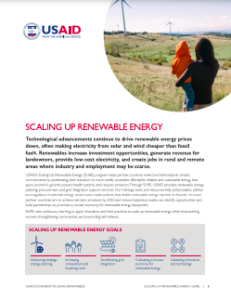
USAID’s Scaling Up Renewable Energy (SURE) program helps partner countries meet bold international climate commitments by accelerating their transition to more widely accessible, affordable, reliable, and sustainable energy that spurs economic growth, powers health systems, and reduces emissions.
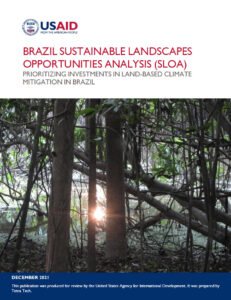
Brazil has immense potential for land-based climate mitigation—also referred to as Natural Climate Solutions (NCS). By most assessments, Brazil has more potential for NCS than any other country.
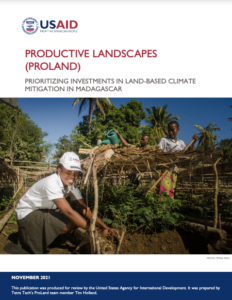
The goals of this report are to familiarize the reader with possible SL interventions in Madagascar; to evaluate the magnitude of the climate mitigation potential of each of those interventions; to gather spatially-explicit data showing what parts of the country could be prioritized for different interventions; and to identify gaps and limitations in the existing data.
This report reviews the challenges and opportunities for donors such as USAID to engage in the mining sector in developing countries as it relates to the green energy transition. Although 29 minerals were identified as playing a current or potential role in green energy technologies, this study reviewed 16 mined in USAID-presence countries that are projected to be particularly important, including 9 that are on the 2018 US Critical Minerals list.
Trabalhando lado a lado com organizações locais, o Programa Regional Ambiental para a Amazônia (AREP, sua sigla em inglês) da USAID vislumbra uma Amazônia saudável e resiliente que seja valorizada pela sociedade, que promova o bem-estar humano e resguarde o nosso clima global.
Trabajando codo a codo con organizaciones locales, el Programa Regional Ambiental para la Amazonía (AREP, por sus siglas en inglés) de USAID anhela y trabaja por una Amazonía saludable y resiliente que es valorada por la sociedad, promueve el bienestar humano, y salvaguarda nuestro clima global.
Working side-by-side with local partners, USAID’s Amazon Regional Environment Program (AREP) envisions a healthy and resilient Amazon that is valued by society, ensures human well-being, and safeguards our global climate.
At COP-26, USAID announced an ambitious set of targets to advance the President’s Emergency Plan for Adaptation and Resilience (PREPARE). PREPARE will support developing countries and communities in vulnerable situations around the world in their efforts to adapt to and manage the impacts of climate change. These impacts are already being felt, and USAID brings significant experience to bear on supporting the climate resilience of developing countries.
PREPARE activates a coordinated, whole-of-government approach to help more than half a billion people in developing countries adapt to and manage the impacts of climate change by 2030.
Through SINAR, the United States Agency for International Development (USAID) supports Indonesia’s goal to expand reliable and equitable energy services to advance sustainable development and inclusive economic growth.
USAID SEGAR brings the government, businesses, and local communities together to make business-as-usual commodities production less harmful to the environment, more beneficial to local farmers, and more profitable for businesses.
This is the final report of the second phase of the Hariyo Ban Program. “Hariyo Ban” means “green forests” in Nepali. The first phase of the Program (Hariyo Ban I) ran from 2011 to 2016, and the second phase (Hariyo Ban II) from 2016 to 2021. This volume contains detailed annexes.