El propósito de este informe es describir el contexto regional, el estado actual y los logros de las iniciativas de biodiversidad y paisaje sostenible de USAID en la cuenca del Amazonas a través de la lente de la Visión Amazónica.
USAID and NREL collaborate in Bangladesh to improve energy access and security and stimulate economic growth through the deployment of advanced energy systems.
The USAID Eastern and Southern Caribbean Mission hosted an eight-session climate change symposium from June 16 to June 30. This virtual symposium focused on renewing and strengthening existing regional partnerships by encouraging dialogue about climate change as well as the sharing of information and opportunities.
Ecuador presents many opportunities for reducing greenhouse gas (GHG) emissions from the agriculture, land use, and forestry sectors. The country has committed to reducing its emissions from land use change by 1.7 million metric tons (Mt) of carbon dioxide equivalent (CO2e) annually, unconditional on any donor investment, and by an additional 6.7 MtCO2e provided sufficient additional investment. An assessment of 16 potential land-based mitigation opportunities found that the total cost-effective potential in Ecuador was in fact about 33.6 MtCO2e annually. That estimate only includes activities that would not have negative impacts on biodiversity or on food and fiber supply.
Trabalhando lado a lado com organizações locais, o Programa Regional Ambiental para a Amazônia (AREP, sua sigla em inglês) da USAID vislumbra uma Amazônia saudável e resiliente que seja valorizada pela sociedade, que promova o bem-estar humano e resguarde o nosso clima global. No total, os programas da USAID na Amazônia contribuíram para a redução de 38,5 milhões de toneladas de emissões de CO2 no ano 2020.
Working side-by-side with local partners, USAID’s Amazon Regional Environment Program (AREP) envisions a healthy and resilient Amazon that is valued by society, ensures human well-being, and safeguards our global climate. In total, USAID programs in the Amazon contributed towards the reduction of 38.5 million tons of CO2 emissions in 2020.
Climate finance in the context of this assessment is defined to include grants, loans, loan guarantees, bonds, equity, and funds for clean energy investments; specialized climate finance facilities, e.g., the Green Environment Facility (GEF) and the Global Climate Fund (GCF); and technical assistance and capacity development programs that create enabling environments to mobilize public and private sector climate finance.
This review provides an overview of the status of mangrove governance and its tenure dimensions globally. It is part of a larger study funded by the USAID Tenure and Global Climate Change Program that includes national-level assessments in Indonesia and Tanzania.
Trabajando codo a codo con organizaciones locales, el Programa Regional Ambiental para la Amazonía (AREP por sus siglas en inglés) de USAID anhela y trabaja por una Amazonía saludable y resiliente que es valorada por la sociedad, promueve el bienestar humano, y salvaguarda nuestro clima global.
This brief introduces CIS, and describes how CIS can be used by resilience food security activities (RFSAs) and partners. The brief lists resources for CIS, and shows where more information can be found. It also introduces national, regional and global CIS providers and partners.
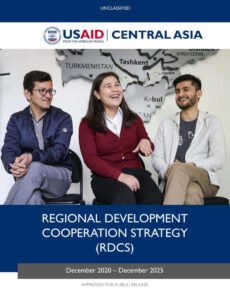
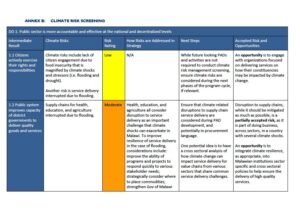
The climate change analysis summarized in this annex aims to inform the USAID/Central Asia Regional RDCS and ensure that the strategy is responsive to climate risks while strengthening Central Asia's resilience and self-reliance.
The climate change analysis summarized in this annex aims to inform the USAID/Southern Africa Regional RDCS and ensure that the strategy is responsive to climate risks while strengthening Southern Africa's resilience and self-reliance.
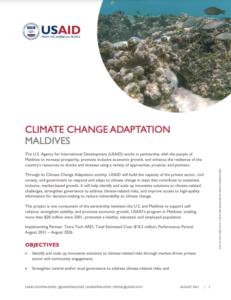
Through its Climate Change Adaptation activity, USAID will build the capacity of the private sector, civil society, and government to respond and adapt to climate change in ways that contribute to sustained, inclusive, market-based growth. It will help identify and scale up innovative solutions to climate-related challenges, strengthen governance to address climate-related risks, and improve access to high-quality information for decision-making to reduce vulnerability to climate change.
USAID programming should strive to close the development gap in each sector in which USAID works by ensuring that Indigenous Peoples’ rights are respected, their knowledge informs and guides program implementation, and they participate as partners in development.
The climate change analysis summarized in this annex aims to inform USAID/Malawi's CDCS and ensure that the strategy is responsive to climate risks while strengthening Malawi's resilience and self-reliance.
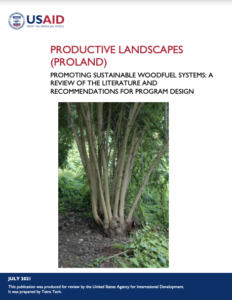
This paper aims to assist development practitioners to strengthen programming intended to reduce the environmental impact of woodfuel harvesting for urban markets. It provides an overview of the woodfuel sector and four components of sustainable woodfuel programming, lists common challenges facing the sector, and includes recommendations intended to orient national-level programming.
The climate change analysis summarized in this annex aims to inform USAID/Somalia's CDCS and ensure that the strategy is responsive to climate risks while strengthening Somalia's resilience and self-reliance.