The purpose of this report is to describe the regional context, the current status and achievements of USAID’s biodiversity and sustainable landscape initiatives in the Amazon basin through the lens of the Amazon Vision.
This report estimates the financial and economic costs of charcoal production from various kiln types, and those of purchasing, operating, maintaining, and replacing various stoves in Lilongwe, Malawi. It also examines the net financial and economic benefits of establishing commercial plantations of wood and bamboo for charcoal production.
This GESI Mainstreaming Checklist for Climate Finance Projects is adapted from materials developed by USAID Climate Ready GESI Specialists working with partners across the Pacific under the USAID Climate Ready Project.
This ESS Toolkit for Climate Finance Projects contains information drawn from ESS technical expertise provided to partners across the Pacific, including Fiji, Federated States of Micronesia and Kiribati, under the USAID Climate Ready Project.
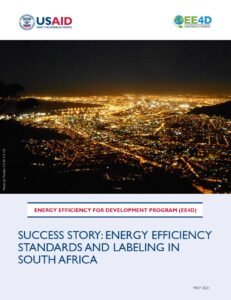
Improving energy efficiency is one of the most cost-effective ways to address the challenges of energy security, high energy prices, air pollution, and climate change.
This Service Planning Toolkit is a resource for SERVIR Hubs as they, with their partners, strive to make an impact in designing, delivering and implementing services.
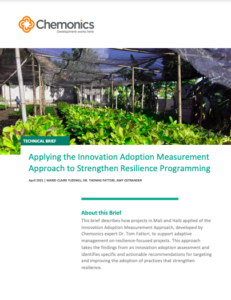
This brief describes how projects in Mali and Haiti applied the Innovation Adoption Measurement Approach to support adaptive management on resilience-focused projects.
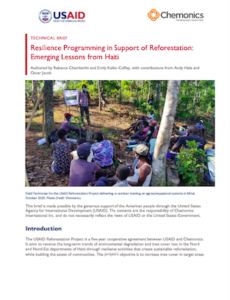
This brief documents lessons-learned from the USAID Reforestation Project in Haiti, including the importance of social capital for resilience and establishing community buy-in.
In late 2020, the USAID Transparency and Long-Term Strategies (T-LTS) project conducted a four-part online training for practitioners on developing mid-century, low-carbon strategies that consider climate risks and include climate adaptation strategies
During September 2020, the USAID Transparency and Long-Term Strategies (T-LTS) project conducted a four-part online training for practitioners on developing mid-century, low-carbon strategies for the transportation sector.
The Integrated Natural Resource Management (INRM) activity provides on-demand support services and technical assistance for USAID Missions, Bureaus, and Independent Offices across a wide array of environmental and natural resource management issues.
The objective of this paper is to share lessons learned from supporting village-level planning within USAID LESTARI’s integrated landscape planning approach for improving forest management within four priority landscapes in Indonesia.
LESTARI supported a range of tools and approaches aimed at building the capacity and commitment of government, community, and private sector partners in more inclusive and equitable forms of land use governance.
The objective of this paper is to share lessons learned from supporting the optimization of the Reforestation Fund to improve forest management within the USAID LESTARI-supported landscape in Central Kalimantan Province.
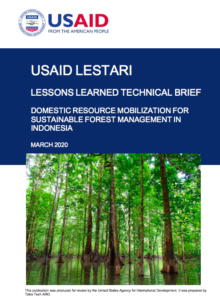
The purpose of this brief is to summarize the lessons learned from USAID LESTARI’s work on Domestic Resource Mobilization for sustainable forest management and conservation in Indonesia.
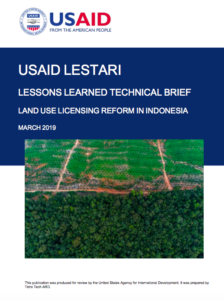
This paper analyses current developments specifically in land use licensing governance in Indonesia and draws out the implications for the work of donors such as USAID supporting land governance programs.
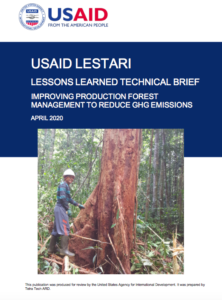
This lessons learned brief discusses the importance of USAID LESTARI engaging with this private sector and the context of production forestry over the last two decades.
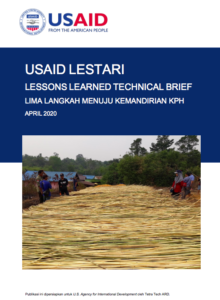
The purpose of this brief is to document the lessons learned from the Forest Management Unit (FMU) strengthening activities in three USAID LESTARI partner provinces – Aceh, Central Kalimantan and Papua.