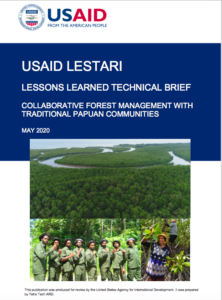
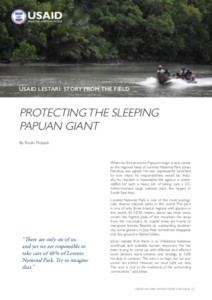
This lesson learned technical brief describes village spatial and development planning, forest and natural resource management, and monitoring and evaluation that contributed to effective collaborative management of Papua’s forests.
USAID LESTARI partners with the Government of Indonesia (GOI) to reduce greenhouse gas (GHG) emissions and conserve biodiversity in carbon rich and biologically significant forest and mangrove ecosystems.
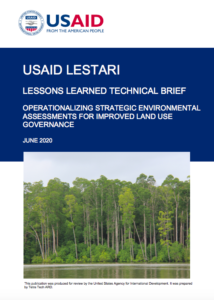
Strategic Environmental Assessments (SEA) are applied to Policies, Plans and Programs (PPP) being designed or revised to ensure that they are based on principles of sustainable development.
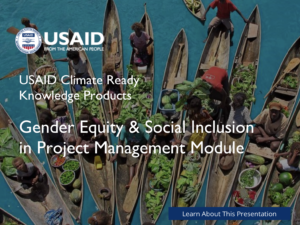
This module is a new learning resource developed by the USAID Climate Ready Project to enhance the Project Management Practice certificate course it is delivering across the Pacific in partnership with University of the South Pacific Technical and Further Education.
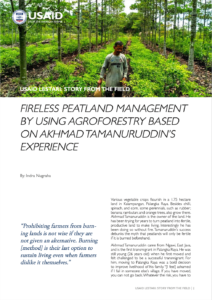
Indonesia’s peatland restoration efforts aim to not only reinstate an ecologically functioning peatland ecosystem, but also to improve local livelihoods.
Although the village fund is one component that is expected to push local potential and accelerate economic development in the villages, the impact from the development is dependent on how pre- pared the village officials are in utilizing the funds.
River Tubing – a recreational activity where an in- dividual rides on top of an inner tube down the river – is a well-known recreational attraction in Agusen Village, Blangkejeren District, Gayo Lues Regency.
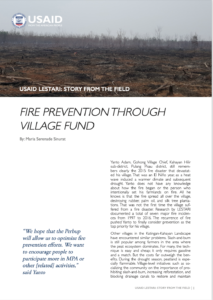
Yanto Adam, Gohong Village Chief, Kahayan Hilir subdistrict, Pulang Pisau district, still remembers clearly the 2015 fire disaster that devastated his village.
This module is a new learning resource developed by the USAID Climate Ready Project to enhance the Project Management Practice certificate course it is delivering across the Pacific in partnership with University of the South Pacific Technical and Further Education.
The climate change analysis summarized in this annex aims to inform USAID/Serbia's CDCS and ensure that the strategy is responsive to climate risks while strengthening Serbia's resilience and self-reliance.
USAID’s LESTARI project supports the Government of Indonesia to reduce greenhouse gas (GHG) emissions and conserve biodiversity in carbon rich and biologically significant forest and mangrove ecosystems.
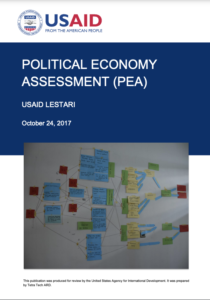
A Political Economy Analysis (PEA) was undertaken as a part of USAID LESTARI’s ongoing mid-term assessment to increase the effectiveness of project strategies, tools and approaches toward meeting high level outcomes for greenhouse gas emissions reduction and biodiversity conservation.
Through its LESTARI project, USAID partnered with the Government of Indonesia (GOI) to reduce greenhouse gas emissions and conserve biodiversity in carbon rich and biologically significant forest and mangrove ecosystems.
USAID partnered with the Government of Indonesia (GOI) to reduce greenhouse gas (GHG) emissions and conserve biodiversity in carbon rich and biologically significant forest and mangrove ecosystems.
USAID LESTARI supports the Government of Indonesia to reduce greenhouse gas (GHG) emissions and conserve biodiversity in carbon rich and biologically significant forest and mangrove ecosystems.