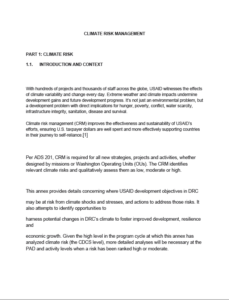
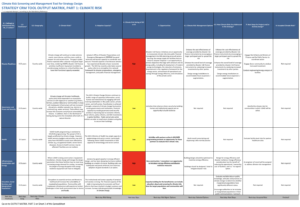
The climate change analysis summarized in this annex aims to inform USAID/Democratic Republic of the Congo's CDCS and ensure that the strategy is responsive to climate risks while strengthening Democratic Republic of the Congo’s resilience and self-reliance.
The climate change analysis summarized in this annex aims to inform USAID/Jamaica's CDCS and ensure that the strategy is responsive to climate risks while strengthening Jamaica’s resilience and self-reliance.
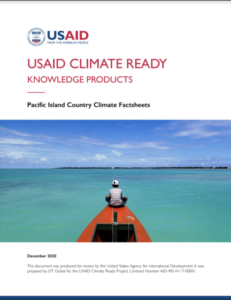
This tool contains data and information drawn from a USAID-supported Climate Change Adaptation Project Preparation training course delivered to government and non-government partners in 10 countries across the Pacific under the USAID Climate Ready Project.
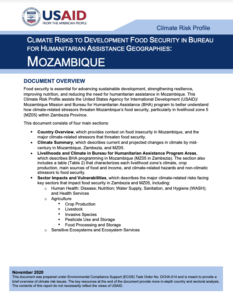
Mozambicans experience high rates of chronic food insecurity. Chronic malnutrition is most widespread in the northern provinces—including Zambezia—where populations experience high rates of chronic food insecurity, and less access to health services, water, sanitation, and education.
Haiti is one of the most food-insecure countries in the world: around 70 percent of the population is food insecure. Of the BHA target geographies, the Centre department experiences severe chronic food insecurity, while the North-East, South, and Grand’Anse departments experience moderate chronic food insecurity.
Across countries, gender inequality, state fragility, and climate vulnerability present challenges to the well-being of communities and the ecosystems upon which they depend. While much research exists connecting pairs of these issues—for example, the need for gender-responsive approaches to realize climate goals—little attention has been devoted to the intersection of the three issues.
This report’s findings offer helpful insights for co-designing and implementing future interventions for productive landscapes in Mexico. These recommendations provide a blueprint for long-term impact and are based on the understanding that thriving communities can only happen within thriving landscapes.
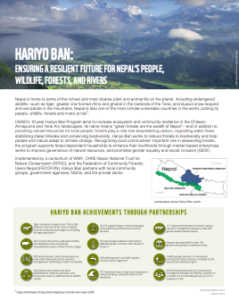
USAID’s 10-year Hariyo Ban Program aims to increase ecosystem and community resilience in the Chitwan-Annapurna and Terai Arc landscapes. Its name means “green forests are the wealth of Nepal”—and in addition to providing natural resources for local people, forests play a vital role sequestering carbon, regulating water flows, stabilizing steep hillsides and conserving biodiversity.
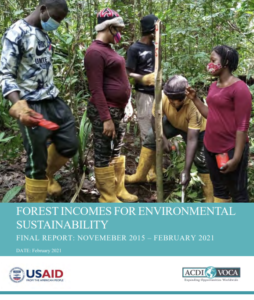
The Forest Incomes for Environmental Sustainability (FIFES) activity was a five-year USAID initiative, implemented by ACDI/VOCA with sub awardees Pact and the Center for International Forestry Research (CIFOR). FIFES was designed to combat deforestation and loss of biodiversity while developing key rural forest-based enterprises that provide sustainable economic opportunities for farmers and forest-dependent communities. FIFES contributed to USAID/Liberia's overall sustainable economic growth program to promote equitable and sustainable market-led economic opportunities in Liberia, accompanied by improved natural resources management.
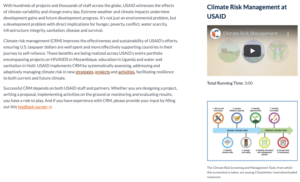
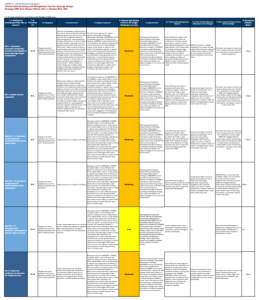
USAID implements CRM by systematically assessing, addressing and adaptively managing climate risk in new strategies, projects and activities, facilitating resilience to both current and future climate.
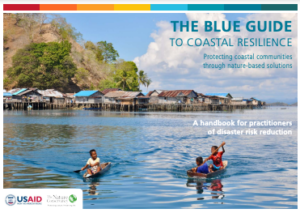
This Blue Guide is primarily designed for practitioners, particularly those in the humanitarian sector supporting coastal communities. This includes technical experts and project managers who will be able to follow the various stages in this guide, who can integrate NbS into DRR planning, implement such plans, and scale up good practices. To use this guide, expertise in ecology and prior knowledge of NbS is not necessary.
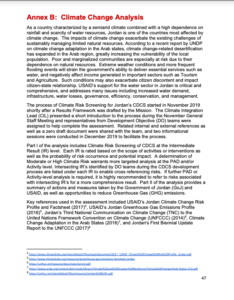
The climate change analysis summarized in this annex aims to inform USAID/Jordan’s CDCS and ensure that the strategy is responsive to climate risks while strengthening Jordan’s resilience and self-reliance.
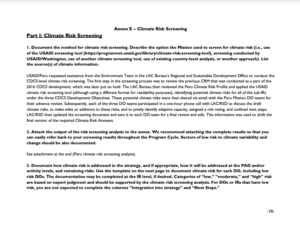
The climate change analysis summarized in this annex aims to inform USAID/Peru’s CDCS and ensure that the strategy is responsive to climate risks while strengthening Peru’s resilience and self-reliance.
The climate change analysis summarized in this annex aims to inform USAID/Guatemala’s CDCS and ensure that the strategy is responsive to climate risks while strengthening Guatemala’s resilience and self-reliance.
The climate change analysis summarized in this annex aims to inform USAID/Colombia’s CDCS and ensure that the strategy is responsive to climate risks while strengthening Colombia's resilience and self-reliance.
The climate change analysis summarized in this annex aims to inform USAID/India’s CDCS and ensure that the strategy is responsive to climate risks while strengthening India’s resilience and self-reliance.
This report summarizes the activities of the Partnership to Advance Clean Energy Deployment 2.0 (PACE-D 2.0 RE) program from June 2019 to September 2020.
This guide is a practical resource developed to educate stakeholders on how to integrate Food Loss and Waste reduction into agricultural value chain selection.