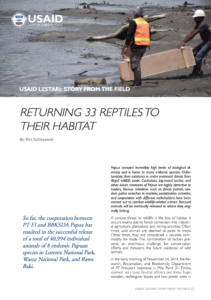
Papua contains incredibly high levels of biological diversity and is home to many endemic species. Unfortunately, their existence is under imminent threat from illegal wildlife trade.
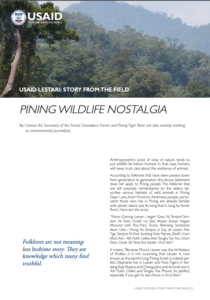
Traditional songs and folklores of Pining people display local wisdoms about ensuring the sustainability of wild animals and the entire Leuser ecosystem.
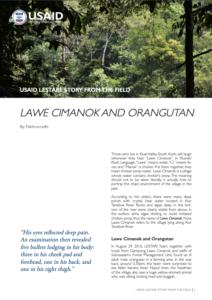
The Leuser Landscape in Aceh Province is home to some of nature’s best work. This area is known as a biodiversity hotspot, with the rich forest ecosystem serving as habitat for a number of endemic, globally-valued species such as Sumatran Orangutan, elephants, rhinos, and tigers.
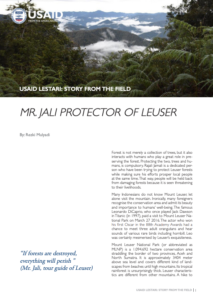
Forest is not merely a collection of trees, but it also interacts with humans who play a great role in preserving the forest. Protecting the two, trees and humans, is compulsory.
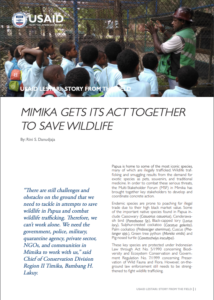
Papua is home to some of the most iconic species, many of which are illegally trafficked. Wildlife trafficking and smuggling results from the demand for exotic species as pets, souvenirs, and traditional medicine.
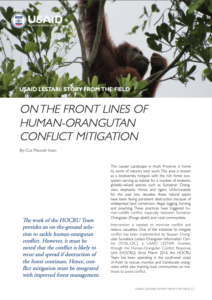
Human-orangutan conflict is usual in other regions, especially in plantations near to forest. Most of the local people are aware that orangutan is an endangered and protected species. Nevertheless, they are often injured or even killed because they are considered pests to their plantations.
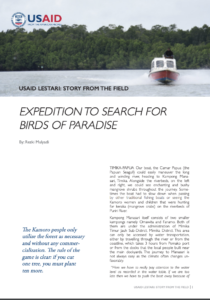
Kampong Manasari itself consists of two smaller kampongs namely Omawita and Fanamo. Both of them are under the administration of Mimika Timur Jauh Sub-District, Mimika District.
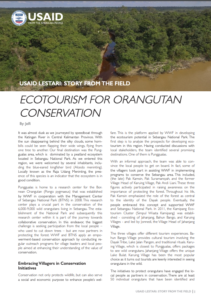
Punggualas is home to a research center for the Bornean Orangutan (Pongo pygmaeus) that was established by WWF in cooperation with the Management Center of Sebangau National Park (BTNS) in 2008. This research center plays a crucial part in the conservation of the 6,000-9,000 wild orangutans living in Sebangau.
This report presents results from the performance evaluation of climate risk management (CRM) at the United States Agency for International Development (USAID).
This Gender Equity and Social Inclusion Project Management Workbook is a new learning resource developed by the USAID Climate Ready Project. It focuses on equity and inclusion aspects of project design, management, monitoring and evaluation (M&E). While this Workbook is relevant to the design and management of projects in any sector, it has a special focus on addressing gender equity and social inclusion (GESI) in development and climate change adaptation (CCA) initiatives.
Well-functioning climate services can play a critical role in managing the risks of a changing and variable climate, helping decision-makers understand, anticipate, and manage climate-related risks across a range of time scales, from days to decades.
The design and implementation of effective climate information services (CIS) requires understanding the extent to which they impact the decisions and lives of those who use them.
To help manage the far-reaching risks of a changing and variable climate in Africa, investments in climate services must simultaneously meet context-specific needs and have a broad scale impact. However, making this investment work for smallholder farmers, at scale, has been challenging.
This is a webinar of the virtual soft launch of the Food Loss and Waste Value Chain Selection Guide. The Food Loss and Waste Value Chain Selection Guide has been developed with funding support from USAID Sustainable Landscapes Program and USDA Foreign Agricultural Service.
USAID Sustainable Landscapes Program and USDA Foreign Agricultural Service worked with Agribusiness Associates on an applied research project to enable greater investments in Food Loss and Waste (FLW) and integrate FLW into climate-smart agriculture programming.
The Rabo Foundation and USAID Green Invest Asia and South Pole assessed the foundation’s emissions from investments into agricultural cooperatives and small and medium enterprises in Indonesia.
USAID believes that gender equality and women’s empowerment are fundamental for the realization of unalienable human rights—that is, rights inherent in all persons and that are universal and non-transferable—and key to effective and sustainable development outcomes. For societies to thrive, women and girls must have equal and safe access to resources, such as education, health care, capital, technology, water and sanitation services, land, markets, and justice.