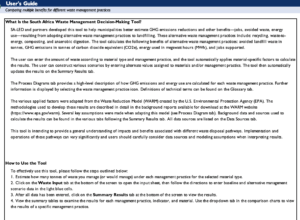
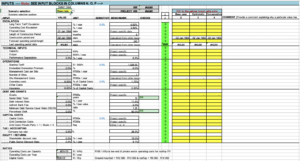
To help the Government of South Africa reduce its waste footprint, the USAID South Africa Low Emissions Development (SA-LED) program developed the South Africa Waste Management Decision-Making Tool.
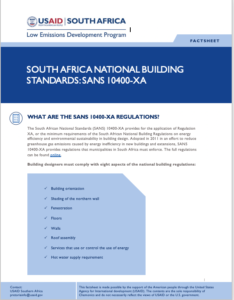
The South African National Standards (SANS) 10400-XA provides for the application of Regulation XA, or the minimum requirements of the South African National Building Regulations on energy efficiency and environmental sustainability in building design.
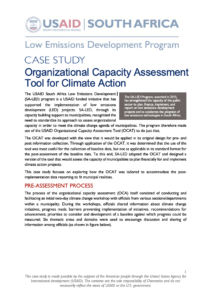
The USAID South Africa Low Emissions Development (SA-LED) program adapted the Organizational Capacity Assessment Tool (OCAT) to assess organizational capacity of municipalities in South Africa to plan financially for and implement climate action projects.
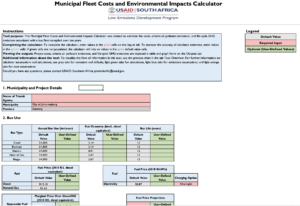
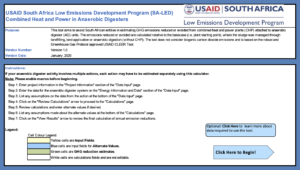
This calculator can be used to estimate the costs, air pollution emissions of fossil fuel and alternative bus fleets, and greenhouse gas emissions associated with a given municipal bus fleet over ten years.
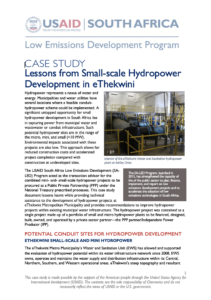
A significant untapped opportunity for small hydropower development in South Africa lies in capturing power from municipal water and wastewater, or conduit infrastructure.
Wastewater treatment plants consume electricity for the operation of equipment and produce methane gas, a greenhouse gas, from the process of anaerobic digestion, used to break down solid waste.
Wastewater treatment plants consume electricity for the operation of equipment and produce methane gas, a greenhouse gas, from the process of anaerobic digestion, used to break down solid waste.
Wastewater treatment plants consume electricity for the operation of equipment and produce methane gas, a greenhouse gas, from the process of anaerobic digestion, used to break down solid waste.
Wastewater treatment plants consume electricity for the operation of equipment and produce methane gas, a greenhouse gas, from the process of anaerobic digestion, used to break down solid waste.
Wastewater treatment plants consume electricity for the operation of equipment and produce methane gas, a greenhouse gas, from the process of anaerobic digestion, used to break down solid waste.
The USAID APIK project began in November 2015 with the overarching aim of supporting the Indonesian government, communities and businesses be more resilient to climate and weather-related disasters.
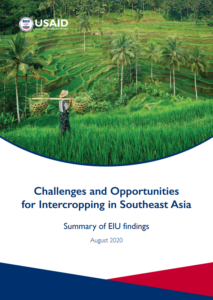
Intercropping in Southeast Asia is shown to have a higher yield than the more widely used slash-and-burn farming. Studies on the impact of intercropping and its advantages over monoculture find four key ecological benefits.
Competition over natural resources, including water, is often viewed as a driver of conflict and has emerged as a key component in many current and past conflicts.