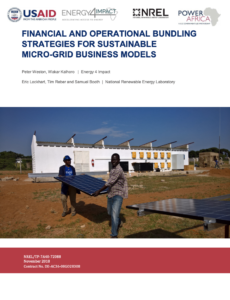
Micro-grids are expected to play a critical role in providing electricity access to the roughly 600 million people in Sub-Saharan Africa who currently lack electricity.
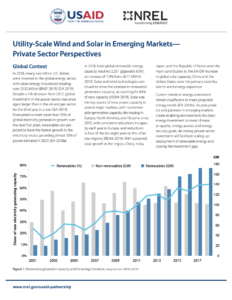
Forecasted to meet more than 70% of global electricity generation growth over the next five years, renewables are projected to have the fastest growth in the electricity sector, providing almost 30% of power demand in 2023.
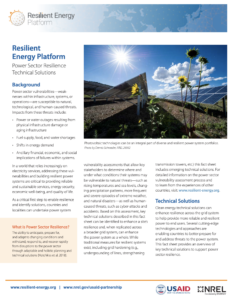
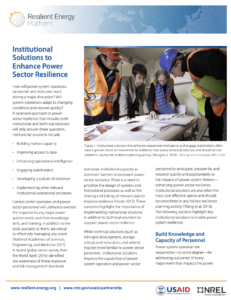
Power sector vulnerabilities—weaknesses within infrastructure, systems, or operations—are susceptible to natural, technological, and human-caused threats.
Great strides have been made in electrification over the last two decades, however, an estimated 1.1 billion people—roughly 600 million of whom live in Sub-Saharan Africa—still lack access to modern electricity services.
USAID Bangladesh and the U.S. Department of Energy’s National Renewable Energy Laboratory partnered with the Government of Bangladesh to develop a national wind resource assessment.
The costs of renewable energy-based electricity generation have fallen in recent years to levels that are increasingly competitive with traditional generation.
Micro-grids will be a critical element of extending modern electricity services to the roughly 600 million people in sub-Saharan Africa who currently lack it, yet barriers remain to micro-grid deployment at scale.
The question of what role grid-scale battery storage plays in a power system has gained prominence because of the increasing need for power system flexibility coupled with the rapid decline in the cost of storage technologies, particularly lithium-ion batteries.
This guidebook can be used by policymakers, power sector investors, planners, system operators, and other energy-sector stakeholders to facilitate discussions and complete key steps of a power sector resilience planning process.
The potential for energy efficiency to simultaneously address economic development, energy security, and environmental protection in countries around the world is well known.
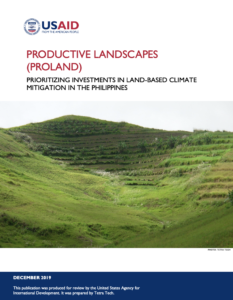
In the Philippines, the largest biophysical potential for land-based climate mitigation is in the forest sector: forest protection represents more than 70% of the biophysical potential for mitigation.
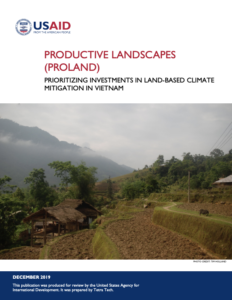
In Vietnam, the largest land-based emissions sector is rice cultivation, both as a result of methane release from flooded paddies as well as from the use of nitrogen-based synthetic fertilizers.
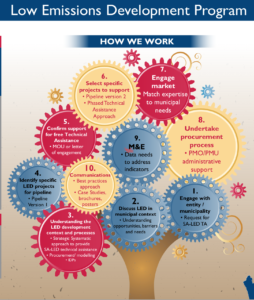
SA-LED works to support the implementation of South Africa’s climate change response policy through supporting low emissions development (LED) project development, capacity building, and promoting an enabling environment for LED.
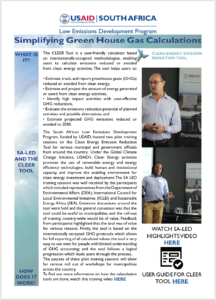
The Clean Energy Emission Reduction (CLEER) tool is a calculator that helps users to estimate and report greenhouse gas emissions reduced or avoided from clean energy activities.
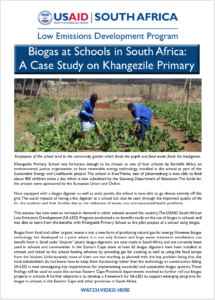
Khangezile Primary School was one of four schools chosen by Earthlife Africa, an environmental justice organization, to have renewable energy technology installed as part of the Sustainable Energy and Livelihoods project.
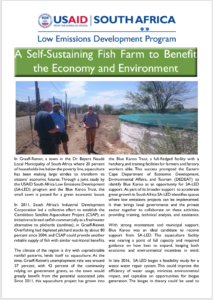
As part of its support to mainstream low emissions development, the South Africa Low Emissions Development (SA-LED) Program supported Blue Karoo Trust, a fish farm specializing in breeding catfish as an alternative to pilchards to sell commercially.