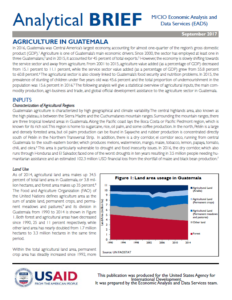
This brief gives a statistical overview of agricultural inputs, main commodity production, factors affecting agri-business development, agricultural trade, and global bilateral official development assistance to the agriculture sector in Guatemala.
This resource guide is aimed at providing practitioners involved in the planning and development of sustainable infrastructure projects with a better understanding of green infrastructure (GI).
This report presents the findings, conclusions, and recommendations from a performance evaluation of the Enhancing Capacity for Low Emission Development Strategies (EC-LEDS) program.
This report provides an overview of the USAID Climate Change Adaptation Project Preparation Facility for Asia and the Pacific (ADAPT Asia-Pacific) project which was implemented from 2011-2017.
This policy note describes the key elements of a conceptual framework designed to guide the activities of the Gender, Climate Change, and Nutrition Integration Initiative (GCAN).
This guidebook seeks to help power system planners, developers, key decision makers, and stakeholders understand and use the REZ transmission planning process to integrate transmission expansion and renewable energy generation planning.
This assessment has been conducted to identify and understand the degree to which gender considerations have been addressed in energy policies, plans and strategies worldwide.
This executive summary written by TFA 2020 and the World Economic Forum outlines 10 priorities to remove tropical deforestation from commodity supply chains in an effort to mitigate global climate change.
This report written by TFA 2020 and the World Economic Forum provides a thorough overview of the 10 priorities to remove tropical deforestation from commodity supply chains in an effort to mitigate global climate change.
This training package is a standalone capacity building program targeted at government officials and climate change practitioners, focusing on integrating gender into climate change adaptation (CCA) practices.
Developed by USAID Adapt Asia-Pacific and hosted by the Asia-Pacific Adaptation Network (APAN), this Sourcebook is a live document that will be periodically updated.
This report documents and analyzes incentives for RE power currently being implemented in several ASEAN countries: namely, feed-in tariffs, self-consumption schemes, tax incentives, soft loans, and other incentives.
The overall objective of this document is to support the consideration of climate change risks and adaptation in USAID infrastructure development activities.
This resource focuses on one of Forest-PLUS’s pilot landscapes in the Rampur Working Circle of Hamachal Pradesh, India, a region often utilized as a source of forest products and ecosystem services for humans.
With support from USAID/Mozambique and the USAID Global Climate Change Office, CEADIR prepared cost-benefit analyses (CBAs) of mangrove restoration for coastal protection and an earthen dike alternative in Quelimane, Mozambique.